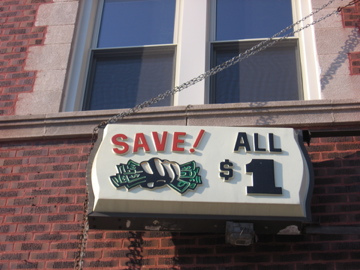
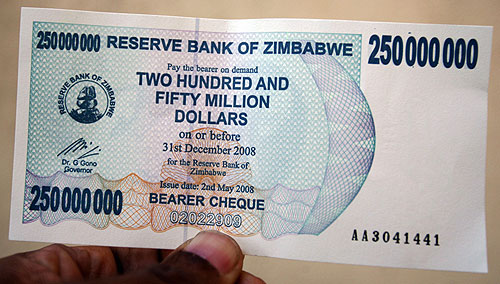
...must have really stunk.



 At a workshop today some of us were talking about the "Buy American" wording in the stimulus package. My question is this- can you go a month buying only American made products? How about for a week? A day? Is it even possible? Extra credit to the first person that can go a month only purchasing things made in the USA.

This is the second opinion piece on the current stimulus plan. Just like yesterday’s post, the following opinion is of the author and not the Georgia Council. Today we will hear from Amy Hennessy, a teacher at Davidson Fine Arts Magnet School.
Mitigating the Downturn
Most mainstream economists have embraced the Keynesian argument that refutes Say’s law about prices and wages being completely flexible and the SRAS curve being vertical. If, as Keynes theorizes, aggregate supply will be upward sloping in the short run when there is a decrease in aggregate demand wages and prices will be sticky. As a result RGDP will decrease and a recessionary gap will emerge. We are currently facing the prospect of an estimated two trillion dollar recessionary gap.
When Okun's law is applied to the current unemployment rate as reported by the Nobel Prize winning economist Paul Krugman one can appreciate the potential implications of the stimulus plan. President Obama’s Director of OMB, Peter Orszag, in 2001 wrote a paper that referenced a study concerning the impact of unemployment compensation as an automatic stabilizer helping to mitigate the full impact of a drop off in aggregate demand. He and Nobel Prize winning economist Joseph Stiglitz authored a paper in 2001 arguing in favor of spending increases over continued tax decreases. Even though monetary policy actions have come to guide most macro policymaking actions over the past few decades, we are now facing the prospect of a liquidity trap and thus must turn to fiscal stimulus alternatives.
A fundamental truth about an economy in contraction is that real people are the ones having to make the agonizing choices about how to put food on the table, get their child to the doctor without any medical coverage because it disappeared with the job, and a roof over their family’s head. The American Recovery and Reinvestment Act of 2009 provides extensions for automatic stabilizers along with the discretionary spending allocated to long overdue infrastructure projects , weatherization and renewable energy projects, as well as school renovations and upgrades.
Sixty percent of respondents think the recently passed stimulus plan will modestly help the economy overcome recession. Infrastructure improvements, unemployment expansion and personal tax-rate cuts were seen as the most effective parts of the plan. (National Association for Business Economics survey)
The $787 billion economic stimulus package recently signed into law should increase demand and production over the next two years, Mr. Bernanke said, before adding that “the timing and the magnitude of the macroeconomic effects of the fiscal program are subject to considerable uncertainty.” Even as the stimulus plan seeks to lay the groundwork for self-sustaining recovery, he said, this would depend heavily on a return to financial stability. And on that front, he said, “more needs to be done.”
The federal budget will provide some support to the economy in 2009 and 2010, even in the absence of any new stimulus legislation. Federal tax liabilities (and therefore revenues) fall proportionately more than incomes in recessions, and that additional drop dampens the decline in households’ real after-tax spending power. In addition, spending on some programs, such as those providing unemployment insurance and the Supplemental Nutrition Assistance Program (formerly known as the Food Stamp program), automatically increases during recessions. Those recession-induced changes in the federal budget tend to smooth out economic cycles. The magnitude of those “automatic stabilizers” can be only roughly estimated, but in CBO’s forecast about $250 billion of the change in the deficit (about 1.8 percent of GDP)between 2008 and 2009 appears to be attributable to them.1 In contrast, spending by state and local governments will only mildly ease the downturn in economic activity.
In response to lower-than-expected revenues and requirements for balanced budgets, they are cutting back their spending on goods and services, and CBO’s forecast assumes essentially no real growth in that spending this year. Total state and local deficits (including both the operating and the capital accounts) will increase, but the change in the total deficits will be small relative to the recession-induced change in the federal deficit. A major source of uncertainty in the outlook is the degree and persistence of turmoil in financial markets and the resulting impact on the future course of the economy.
Many financial instruments and practices that contributed to the financial crisis came into widespread use only in the past decade, and the scale of the problems and the worldwide linkages of financial markets are significantly different from what they were in previous episodes of financial stress in the United States. Furthermore, the scale and novelty of federal intervention, particularly by the Federal Reserve, and uncertainty about the degree to which those interventions will affect the economic outlook, make it particularly difficult for analysts to use historical patterns to forecast the near future. (From report of the Congressional Budget Office.)
NYT's David Leonhardt "...for all the criticism the stimulus package has been getting, it does pretty well by several important yardsticks. First of all, the package really is stimulus. It will quickly give money to the people who have been hardest hit by the recession and who, not coincidentally, will be most likely to spend that money soon. The spending also has a chance to do some long-term good, by paying for the computerization of medical records, the weatherization of homes and other such investments...”
“The only way to increase aggregate demand is going to be through” government spending on roads, bridges and other infrastructure, Roubini said at a Bloomberg conference in New York. “We need a huge plan… (NYU Professor of economics Nouriel Roubini, a man who has been vindicated for his prognostications that had been widely disregarded by many in the mainstream prior to this meltdown.)
Joseph Stiglitz also noted that the previous stimulus did little to address the rise in foreclosures in the United States, which he said was central to the economic crisis. He also said solving the “crisis” outweighed any concerns over deficit spending and the national debt. The Nobel Prize winner also said people are only looking at one side of the nation’s balance sheet, the liability side and ignoring the asset side. According to Stiglitz, the assets the government will accrue, no matter how illiquid they are, will offset the huge debt liabilities the Obama administration would run up with a stimulus project. “The deficit is only one side of a country’s balance sheet – it’s the liability,” Stiglitz said. “We also have to look at the asset side and that’s why he’s been emphasizing not only that we borrow, but we use it to buy assets that increase the asset side of our balance sheet.”