Feb 28, 2009

Look Out Below

You may want to save this graph for your Macro unit. Everyone knows that GDP is declining but this really does put it all into perspective.

If you go here you can find GDP quarterly changes since 1930. Have your students compare GDP growth rates over the years to give them a better understanding of what this 6.2% drop means.

10.1%? Holy smokes.


Feb 27, 2009

Georgia Economic History

Returning from a recent GCEE workshop, Economics in Georgia History, I promptly filed away all of my materials from the course neatly in a notebook, and contemplated tackling the daunting stack of papers on my desk from my students’ work with the substitute.

Within a day I found myself pulling out my notebook, looking for ideas. Rather than teach the Economics GPS in isolation, I try to incorporate them throughout the year and right in front of me was a lesson “The Least Likely Place for a Race Riot” which not only connected directly to our unit on Civil Rights, but also was an opportunity to teach about the incentive effect of profit and the influence of Robert Woodruff and The Coca-Cola Company.

Having the lesson documents in Word as well as .pdfs let me adapt the work to my classroom. The lesson focuses on the contrast between Atlanta’s peaceful desegregation and Birmingham and Montgomery’s experiences, so I included a video clip from this site to review the Montgomery bus boycott. It woke my students up a little with its dramatic images. Not surprisingly, students of all races are surprised and shocked by the brutality of the times.

*Post submitted by Liz Williams, Henderson Middle School

That's right, we even have workshops that cover economics in the middle grades!

Feb 26, 2009

From the Classroom vol 8

It is that time of the semester.

This cartel game from the Foundation for Teaching Economics is my favorite part of my micro unit.

By this time, the class has discussed how firms in an oligopoly have an incentive to collude, if allowed. This game demonstrates that, but also demonstrates the incentive for those firms to break that agreement. And that is where the fun begins. The students collude to drive up prices, but then recognize that if all the other groups follow the agreement and they do not, their profits will increase. A great way top off this activity is certainly to discuss OPEC and their quotas.

I feel confident in saying that if you give this activity a shot, it will become a favorite of both you and your students (once they get over being enraged by the deal-breaking.) So sit back, watch the backstabbing happen. The best part—the consumers benefit from every agreement that gets broken.

Feb 25, 2009

WHEEEEEEEEEEEE!

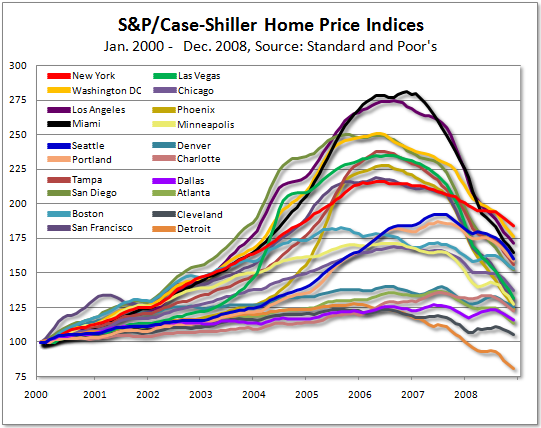
See how home sales are doing in your favorite city.

Feb 24, 2009

Paging Dr. Doom

“Doctor Doom”, Nouriel Roubini, now beats the drum for government takeover of the most troubled banks. (Citi closed at $1.95/share Friday.) With Alan Greenspan and Senator Lindsay Graham jumping on this bandwagon is the dirty word, nationalization, a pending reality? Would temporary government ownership of these insolvent institutions keep us from facing a decade like Japan’s lost decade of the ‘90’s? Sweden did it successfully. Do we have the political will to follow their lead?

*Post submitted by Amy Hennessy, Davidson Fine Arts Magnet School

Feb 20, 2009

A Million Silver Linings

It is time to start compiling a list of all of those "the economy is a complete wreck but this positive thing is happening" stories that keep popping up in the news. This one may be hard to top but I am going to kick this new feature off with it anyway. (Much like NASCAR starting the season with the Daytona 500, it just goes downhill from there.) Let us know when you find a good news/bad economy story of your own.

Now cue the theme from Jaws....

Watch the Banker Wizards


That explains some things.

Feb 19, 2009

From the Classroom vol 7

Our students use markets everyday and it is not usually a challenge to get them to notice this fact. It can, however, be a bit harder to get them to come up with real world examples of scarce resources not being allocated by markets. This is the time in the semester when I like to pick my "deputy."

The deputy (or Cap'n as I like to sometimes call him/her) is a member of the class who gets a "WINNER" medal and gets as many special privileges as you are comfortable granting. I give my deputy a wide leash to leave the room whenever he/she wants, settle disputes, and make important decisions in the classroom. The point is to give the office enough power to make it desirable.

The students come up with non-market ways in which we could allocate this very scarce resource and then vote as a class to see who should be selected. Foot races, spelling bees, rock/paper/scissor tourneys, raffles, and trasketball have all given me deputies over the years. Once the deputy is picked, we launch into a discussion of real world examples of non-market allocation. Kids learn econ and I acquire a big time ally that the students themselves had a hand in picking. I believe Michael Scott would call that a win-win-win situation.